
Description
Product Overview
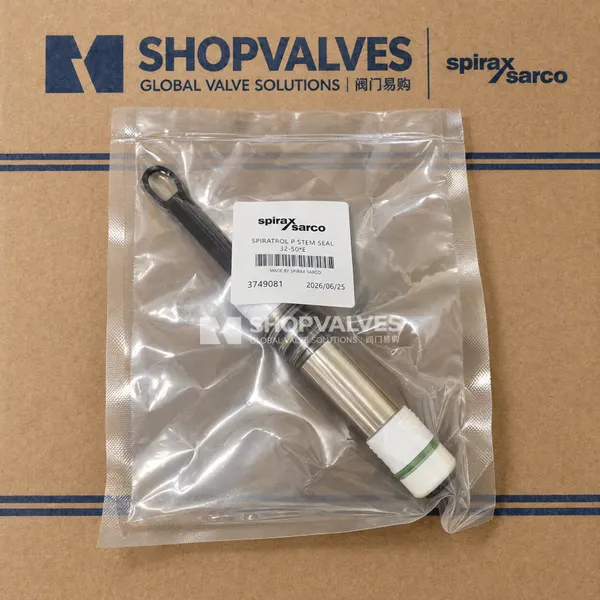
Spirax Sarco Spira-trol PTFE stem seal kit is a genuine factory replacement gland packing set engineered specifically for Spira-trol two-port globe control valves. The assembly prevents line media from escaping along the reciprocating valve plug stem in saturated steam, liquid, and gas installations while maintaining minimal friction for modulating actuator control.
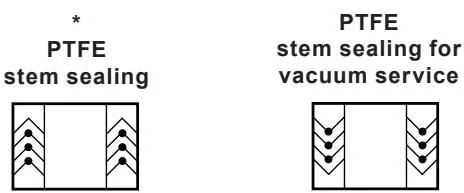
Supplied under spare parts designation Kit C, the PTFE stem seal package includes the complete internal stack: spring-loaded chevron V-rings, glass-filled PTFE stem guides, Viton secondary elastomeric O-rings, a packing guard washer, a lower wiper, an upper scraper ring, and replacement graphite/stainless steel bonnet gaskets. It corresponds to standard bonnet option P and option N across both EN (PN-rated) and ASME Spira-trol body executions.
Key Features
- Spring-energised chevron packing: an internal 316L stainless steel spring maintains constant live loading on the PTFE V-ring set, compensating automatically for packing wear and thermal cycling without requiring manual adjustment.
- Dual-bearing alignment: upper and lower stem guides manufactured from glass-filled PTFE provide rigid stem guiding, eliminating lateral deflection and preventing galling against the bonnet bore.
- Ingress and particulate exclusion: a lower PTFE wiper ring and an upper PTFE scrapper ring prevent process debris and atmospheric particulates from migrating into the primary seal stack.
- Secondary sealing boundary: inner and outer Viton O-rings provide secondary sealing around the gland nut interface.
- Metal-to-metal torquing: gland nut tightening requires positive metal-to-metal contact against the bonnet at 20 N m for sizes DN15 to DN100 and 50 N m for sizes DN125 to DN200, eliminating guesswork during field reassembly.
Technical Specifications
| Parameter | Specification Details |
|---|---|
| Compatible Valve Series | Spirax Sarco Spira-trol K Series (KE, KF, KL) and L Series (LE, LF, LL) |
| Host Valve Sizes | DN15, DN20, DN25, DN32, DN40, DN50, DN65, DN80, DN100, DN125, DN150, DN200, DN250, DN300 |
| Primary Seal Profile | Chevron V-ring stack (Bonnet option P and N) |
| Primary Seal Material | Virgin PTFE |
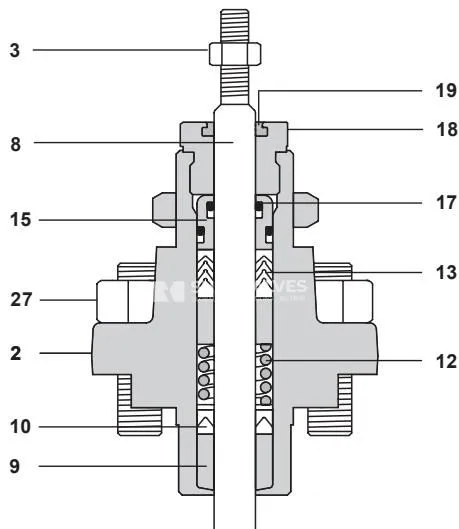
| Guide Bush Material | Glass-filled PTFE (lower guide item 9, upper guide item 16) |
| Elastomer O-Rings | Viton (outer O-ring item 15, inner O-ring item 17) |
| Internal Loading Spring | 316L stainless steel (item 12) |
| Wiper and Scraper Material | PTFE (lower stem wiper item 10, scrapper ring item 19) |
| Metallic Hardware Material | 316L stainless steel (guard washer item 11, packing spacer item 13) |
| Maximum Continuous Operating Temperature | 220 °C (428 °F) |
| Maximum Peak Operating Limit | 250 °C (482 °F) |
| Minimum Operating Temperature | -10 °C (SG iron / cast iron bodies); -29 °C (-20 °F) (Carbon and stainless steel bodies) |
| Maximum Working Pressure | Up to 40 bar g (PN40) / 51.1 bar g (ASME 300) subject to host body envelope |
| Gland Nut Tightening Target | Metal-to-metal bonnet contact: 20 N m (DN15-DN100), 50 N m (DN125-DN200) |
Applications
- Modulating and on/off two-port Spira-trol control valves managing Group 2 gases and liquids in accordance with Pressure Equipment Directive 2014/68/EU.
- Saturated steam pipelines operating at pressures up to 19 bar g within the 220 °C continuous thermal boundary.
- Industrial heat exchangers, condensate recovery lines, and heating systems requiring low-friction stem motion.
- Compressed air, nitrogen, and inert gas control systems operating across standard industrial temperature spans.
Maintenance and Replacement Procedures
Replacement of the PTFE gland packing can be carried out while the valve body remains installed in the pipeline:
- Isolate the valve from fluid pressure upstream and downstream, vent line media to zero atmospheric pressure, and isolate pneumatic or electrical power to the actuator.
- Disconnect the actuator from the valve bonnet following the actuator maintenance instructions.
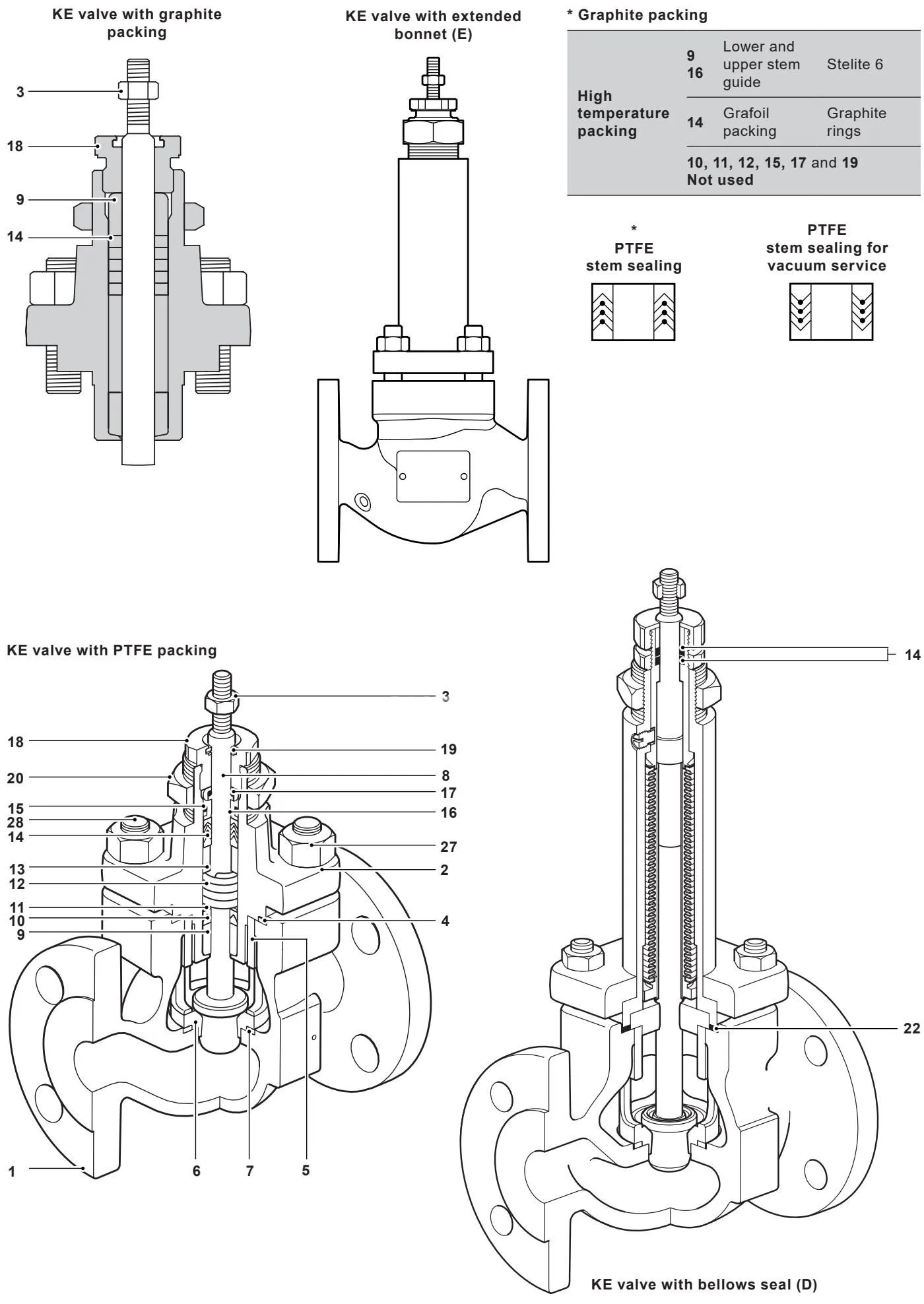
- Remove the stem lock-nut (3) and unscrew the gland nut (18).
- Remove the bonnet nuts (27), lift off the bonnet assembly (2), and safely discard the body-to-bonnet gasket.
- Withdraw the valve plug and stem (8). Remove the gland nut (18) and pry out the worn scrapper ring (19), cleaning the internal groove thoroughly.
- Extract all worn internal gland components (items 9, 10, 11, 12, 13, 14, 15, 16, and 17) from the bonnet cavity and discard them.
- Thoroughly clean the bonnet gland bore and inspect the valve stem for score marks, pitting, or scale deposits, which will cause premature packing destruction if unremedied.
- Assemble the new packing kit into the gland cavity strictly in sequence. Install the lower guide (9) with its radiused/chamfered edge facing downward. Place the PTFE V-rings (14) with their sealing lips oriented correctly against fluid pressure. Use the provided plastic installation tool to position components without pinching, then discard the tool.
- Fit the new scrapper ring (19) into the gland nut (18). Apply a light smear of anti-seize lubricant to the gland nut external threads and screw it in two to three turns; do not compress the packing stack at this stage.
- Fit a new bonnet gasket. Apply a light smear of silicone grease to the top of the valve plug stem before inserting it into the bonnet cover. Refit the bonnet assembly to the body, torquing the bonnet nuts (27) incrementally in opposing pairs according to the published bolt sequence.
- Tighten the gland nut (18) until positive metal-to-metal contact with the bonnet is achieved: torque to 20 N m for sizes DN15 to DN100, or 50 N m for sizes DN125 to DN200.
- Refit the stem lock-nut (3), remount the actuator, reconnect the control signals, and inspect for zero gland leakage upon return to service.
Safety Precautions for Handling PTFE
PTFE is completely inert within its certified operating temperature limit of 220 °C. If heated near or above its sintering threshold of 260 °C (500 °F), PTFE decomposes and releases gaseous polymer fumes capable of causing acute polymer fume fever upon inhalation.
- Enforce a strict no-smoking policy in all workshops and maintenance bays where PTFE components are unpacked, handled, or serviced.
- Avoid carrying PTFE seals or contaminated components in clothing pockets.
- Wash hands thoroughly after completing gland overhaul procedures to remove microscopic fluoropolymer particles before eating or smoking.
- Do not dispose of discarded PTFE components by incineration; collect spent seals in a segregated rubbish container and consign them to an approved industrial landfill site.