
Description
Product Overview
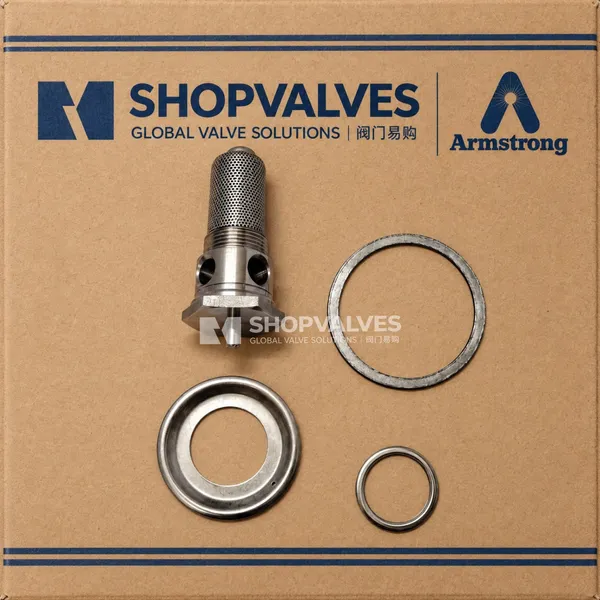
Spirax Sarco BRV2 valve and seat assembly is the primary internal trim replacement kit engineered for BRV2 series direct-acting pressure reducing valves. This factory assembly restores tight shut-off and stable pressure reduction across steam, compressed air, and inert industrial gas lines where seat wear, erosion, or particulate deposition causes downstream pressure drift.
Key Features
- Fully stainless steel wetted trim construction utilizing AISI 420 valve heads, BS 970 431 S29 seats, and ASTM A276 316L pushrods.
- Integral stainless steel strainer screen (BS 1449 316 SH) incorporated directly within the seat assembly to protect internal throttling surfaces from line scale.
- Standardized flow coefficient options with Kvs ratings of 1.5 for DN15, 2.5 for DN20, and 3.0 for DN25.
- Supplied complete with replacement stainless steel valve seat gasket and graphite bellows gasket.
- Compatible with both SG iron (BRV2S, BRV2B, BRV2SP, BRV2BP) and gunmetal (BRV2S5, BRV2B5) valve bodies.
Technical Specifications
| Parameter | Stated Value |
|---|---|
| Compatible Host Valves | Spirax Sarco BRV2S, BRV2B, BRV2SP, BRV2BP, BRV2S5, BRV2B5 |
| Nominal Sizes | DN15 (1/2”), DN20 (3/4”), DN25 (1”) |
| Flow Coefficient (Kvs) | DN15: 1.5; DN20: 2.5; DN25: 3.0 |
| Valve Head Material | Stainless steel AISI 420 |
| Valve Seat Material | Stainless steel BS 970 431 S29 |
| Pushrod Material | Stainless steel ASTM A276 316L |
| Strainer Screen Material | Stainless steel BS 1449 316 SH |
| Valve Return Spring Material | Stainless steel BS 20056 316 S42 |
| Bulkhead Plate Material | Stainless steel 316L |
| Valve Seat Gasket Material | Stainless steel BS 1449 316 S11 |
| Bellows Gasket Material | Stainless steel reinforced exfoliated graphite |
| Seat Installation Tool & Torque | 32 mm A/F spanner, 108 - 132 N m (80 - 97 lbf ft) |
| Spring Housing Bolt Torque | 13 mm A/F spanner (M8 x 25), 18 - 24 N m (13 - 18 lbf ft) |
| Maximum Operating Pressure (PMO) | 17 bar g (gunmetal body) / 19 bar g (SG iron body) |
| Maximum Operating Temperature (TMO) | 210 °C (410 °F) |
| Maximum Downstream Pressure | 8.6 bar g (125 psi g) |
| Maximum Recommended Turndown Ratio | 10:1 at maximum flow |
Applications
- Routine preventive maintenance and trim overhaul of Spirax Sarco BRV2 direct acting pressure reducing stations.
- Saturated steam service lines experiencing downstream pressure rise caused by wire drawing, erosion, or seat contamination.
- Compressed air and inert industrial gas distribution networks suffering from hunting or pushrod sticking due to particulate matter.
Assembly Components
The complete replacement assembly unifies all primary throttling and internal guiding parts:
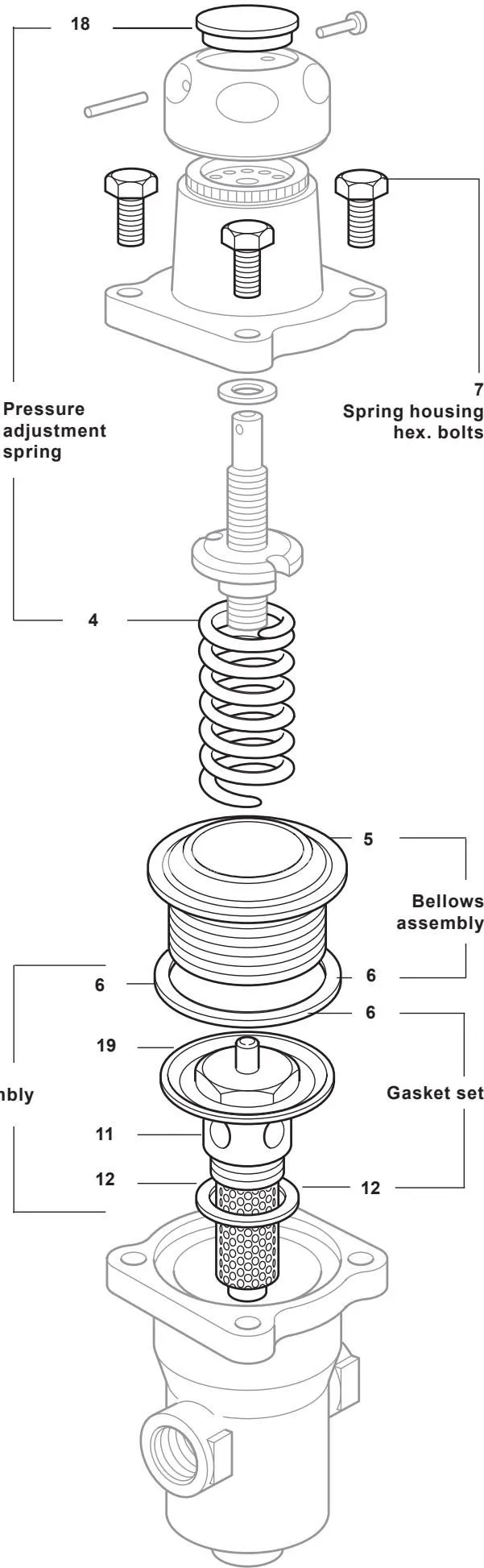
- Item 10: Pushrod
- Item 11: Valve seat
- Item 12: Valve seat gasket
- Item 13: Valve head
- Item 14: Valve return spring
- Item 15: Strainer screen
- Item 19: Bulkhead plate
- Item 6: Bellows assembly gasket
Replacement Procedure
- Isolate the valve from upstream and downstream pressure, ensure the line is safely vented to atmospheric pressure, and allow the valve body to cool.
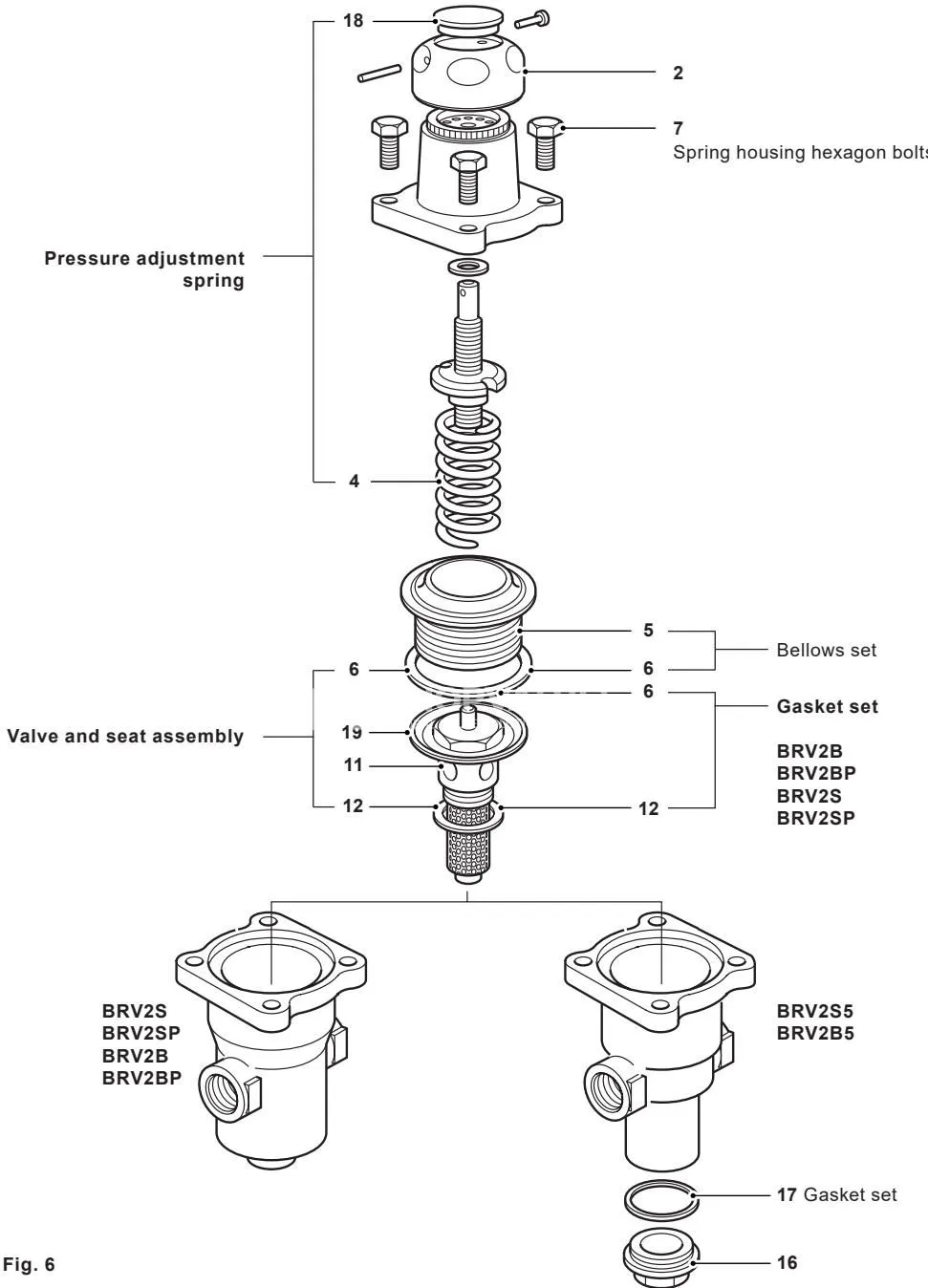
- Release adjustment spring compression by rotating adjustment handwheel (2) fully anticlockwise.
- Remove the 4 spring housing bolts (7) using a 13 mm A/F spanner and lift off the spring housing.
- Withdraw the bellows assembly (5) and bellows gasket (6).
- Using a 32 mm A/F spanner, unscrew the valve seat (11) and remove the valve head, return spring, strainer screen, pushrod, and bulkhead plate / guide bush.
- Thoroughly clean internal seating surfaces and cavity.
- Install the replacement valve and seat assembly with a new seat gasket (12).
- Tighten valve seat (11) using a 32 mm A/F spanner to a torque of 108 - 132 N m (80 - 97 lbf ft).
- Fit a new bellows gasket (6), reinstall bellows assembly (5), and replace the spring housing.
- Tighten the 4 spring housing bolts (7) in an even sequence to 18 - 24 N m (13 - 18 lbf ft).
Fault Diagnosis Addressed by Trim Replacement
- Downstream pressure rises above setpoint under dead-end conditions: caused by erosion, scoring, or foreign matter across the valve seat face.
- Downstream pressure creep caused by blocked internal sensing ports or scale buildup around the valve head.
- Pressure hunting or sluggish control response: caused by pushrod sticking or particulate binding within the guide bush.